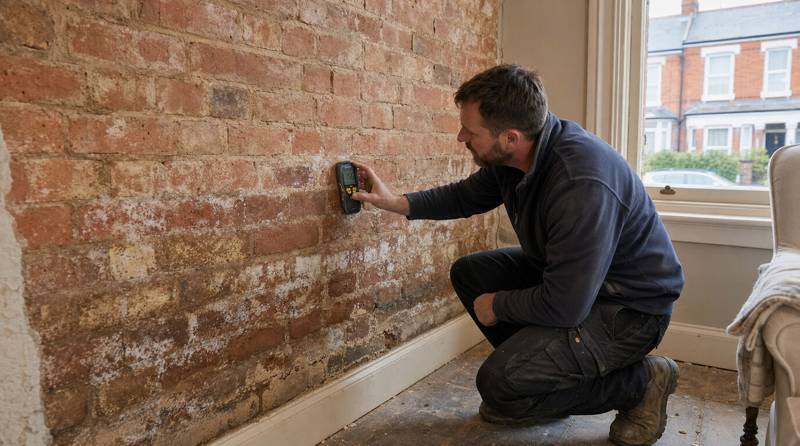
Damp is one of those problems where the price you pay depends entirely on getting the diagnosis right first. Rising damp, penetrating damp and condensation all look similar to an untrained eye but need completely different fixes, and the wrong one wastes money without solving anything.
This guide covers realistic 2026 UK costs for the full range of damp proofing work, from a proper survey through to chemical treatment and full wall tanking.
Damp Survey Costs
Before paying for any treatment, get a proper survey to confirm what type of damp you actually have. This matters because chemical damp proofing does nothing for condensation, and treating the wrong problem is a common way homeowners lose money on this.
| Survey Type | Typical Cost |
|---|---|
| Basic damp survey (small property) | £150 to £250 |
| Full damp and timber survey | £250 to £450 |
| Independent chartered surveyor report | £300 to £600 |
An independent surveyor with no financial interest in selling you treatment is worth the extra cost, since some damp proofing companies have been known to recommend unnecessary chemical courses when the real issue is poor ventilation.
Treatment Costs by Damp Type
Prices vary significantly depending on which type of damp you have and how far it has spread.
| Treatment | Typical Cost |
|---|---|
| Chemical damp proof course (per linear metre) | £15 to £30 |
| DPC injection, small terrace (whole ground floor) | £400 to £800 |
| DPC injection, larger semi or detached | £800 to £1,500 |
| Re-plastering after DPC treatment | £600 to £1,500 |
| Penetrating damp fix (gutter, render, pointing repair) | £150 to £800 |
| Extractor fan or PIV unit for condensation | £150 to £600 |
| Full tanking (basement or cellar wall) | £2,000 to £5,000 |
| External wall waterproofing (larger area) | £1,500 to £4,000 |
Rising Damp, Penetrating Damp or Condensation
Getting this right is the single biggest factor in what you end up paying, and in whether the treatment actually works.
- Rising damp shows as a tide mark up to around a metre high on ground floor walls, often with a musty smell and crumbling plaster. Treated with a chemical damp proof course injected into the brickwork, followed by re-plastering with a salt-retardant plaster.
- Penetrating damp appears as a localised patch, anywhere on a wall or ceiling, usually caused by a specific external fault such as a blocked gutter, cracked render, faulty flashing or a gap around a window. Fixing the external cause is often cheaper than the rising damp route and does not always need chemical treatment.
- Condensation shows up as surface moisture, misted windows and black mould, worst in bathrooms, kitchens and poorly ventilated bedrooms. This is the most common type in UK homes and the cheapest to fix, since it responds to ventilation rather than chemical treatment.
What Affects the Price
- Property size and wall length. DPC injection is typically priced per linear metre of affected wall, so a larger footprint costs more.
- How much re-plastering is needed. Old damp plaster usually has to be removed and replaced with salt-retardant plaster, which often costs more than the DPC treatment itself.
- Access difficulty. Basement and cellar work, or walls behind fitted furniture, cost more due to the extra labour involved.
- Whether it is condensation misdiagnosed as rising damp. Paying for unnecessary chemical treatment when ventilation would have fixed it is the most expensive mistake in this category.
How to Get the Best Price
- Get an independent survey before accepting a quote from a company that also does the treatment. This is the single best way to avoid paying for unnecessary work.
- Get at least three quotes for chemical DPC work. Pricing per linear metre varies more than most trades between companies.
- Check the guarantee is insurance-backed, not just company-backed. A 20 or 30 year guarantee is worthless if the company closes down and the guarantee dies with it.
- Rule out condensation first with cheap fixes. Extractor fans and better ventilation cost a fraction of chemical damp proofing and solve the most common type of UK household damp.
- Ask what the re-plastering allowance actually covers. Some quotes only include the injection and leave re-plastering as a separate, larger cost.
Damp proofing in the UK typically costs £500 to £2,500, with a straightforward chemical DPC injection for a small terrace running £400 to £800 before re-plastering. Get an independent survey first, since condensation is the most common cause of UK household damp and is far cheaper to fix than rising damp, which needs chemical treatment. If you are dealing with wider property issues, our guide on house rewiring costs covers another common older-property expense.