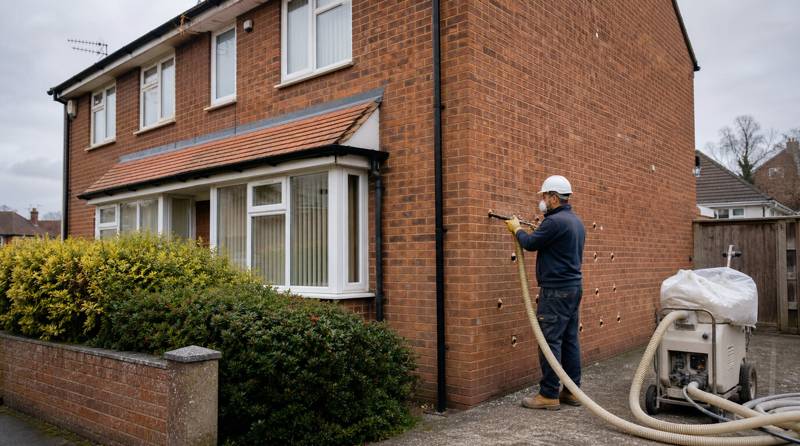
Cavity wall insulation is one of the cheapest, quickest home improvements for cutting heating bills, since the work usually takes a single visit and involves no internal disruption at all. Most homes built after around 1920 have a cavity between the inner and outer wall, and filling that gap with insulation material stops a huge amount of heat escaping straight through the brickwork.
This guide sets out real 2026 UK prices by house size, explains who can get it free through the ECO4 scheme, and covers what actually affects the cost and the savings.
Cavity Wall Insulation Cost by House Size
Price scales directly with the total wall area to be filled, so house size and number of storeys are the biggest factor once a property is confirmed suitable.
| Property Type | Typical Cost |
|---|---|
| Flat or small terraced house | £400 to £800 |
| Mid-terrace house | £500 to £900 |
| Semi-detached house, 2 to 3 bed | £600 to £1,200 |
| End-terrace house | £700 to £1,100 |
| Detached house, 3 to 4 bed | £1,000 to £1,800 |
| Large detached house, 5+ bed | £1,500 to £2,500 |
These prices typically include the borescope survey, drilling, the insulation material itself and making good the small drill holes afterwards, but always confirm exactly what a quote covers before booking.
Getting It Free Through ECO4
The Energy Company Obligation (ECO4) scheme requires large energy suppliers to fund energy efficiency improvements for eligible households, and cavity wall insulation is one of the most commonly funded measures.
- Qualifying benefits route: Households receiving Universal Credit, Pension Credit, Child Tax Credit or several other means-tested benefits typically qualify for a fully funded installation.
- Low EPC rating route: Homes with an Energy Performance Certificate rating of D, E, F or G can also qualify in many local authority flexible eligibility (LA Flex) schemes, even without being on benefits.
- How to check: A CIGA-registered installer or an energy efficiency comparison site can confirm eligibility within a few minutes using postcode, property type and household circumstances, with no obligation to proceed.
Even households that do not qualify for a fully free installation sometimes qualify for a partial subsidy, so it is always worth checking before assuming the full self-funded price applies.
Is Your House Suitable?
Not every property is a good candidate, and installing it in the wrong circumstances is the main cause of problems later.
- Cavity width: The gap needs to be at least 50mm wide, standard for most homes built from around 1920 onwards.
- Cavity condition: Existing damp, debris left over from construction, or wall ties in poor condition can rule a property out until addressed.
- Exposure: Properties in very exposed coastal or hillside locations facing frequent driving rain sometimes need a specialist water-repellent insulation material rather than standard fill, at a modest extra cost.
- Age: Solid brick walls built before around 1920 generally have no cavity to fill and need external or internal wall insulation instead, a different and more expensive job.
A registered installer carries out a borescope survey, typically free with a quote, drilling a small test hole to check the cavity's width and condition before confirming suitability and price.
What Affects the Cost
- Number of storeys: A two-storey semi costs more than a bungalow of similar footprint since there is simply more wall area to fill.
- Access: Straightforward ground and first floor walls cost less than a property needing scaffolding or a tower for upper sections.
- Material type: Standard mineral wool or polystyrene bead fill is cheapest; water-repellent bead for exposed properties adds a modest premium.
- Existing partial insulation: Topping up a property with some existing but inadequate insulation is usually cheaper than a full first-time fill.
- Number of cavities: An extension or outbuilding with its own separate cavity wall adds to the total area and cost.
Energy Bill Savings
The Energy Saving Trust estimates a typical uninsulated semi-detached house loses around a third of its heat through the walls, and filling the cavity saves roughly £180 to £260 a year on heating bills at current prices, with larger detached homes saving proportionally more. A self-funded installation on a typical semi usually pays for itself within 3 to 5 years, after which the saving continues for the lifetime of the insulation, generally 25 years or more. If a renovation has already opened up the walls, it is worth reading alongside our guide to home extension costs, since insulating during other wall work often works out cheaper than a standalone visit.
Ways to Reduce the Cost
- Check ECO4 eligibility first. A large share of UK households qualify for a fully or partially funded installation, and checking takes a few minutes with no obligation.
- Use a CIGA-registered installer. This guarantees a 25-year Cavity Insulation Guarantee Agency warranty covering remedial work, and most mortgage lenders and future buyers expect to see it.
- Combine with loft insulation. Many installers offer a combined discount for doing both in one visit, since loft top-up is a similarly quick, low-disruption job.
- Get at least three quotes. Pricing varies by region and installer, and a written quote should confirm the CIGA guarantee is included as standard.
- Do not delay a borescope survey. It is usually free and quickly rules a property in or out, avoiding wasted time chasing quotes for an unsuitable wall type.
Cavity wall insulation costs £400 to £1,800 depending on house size, with most 2 to 3 bed semis around £600 to £1,200. Check ECO4 eligibility first, since many households qualify for it free or heavily subsidised. Always use a CIGA-registered installer for the 25-year guarantee, and expect a self-funded installation to pay for itself within 3 to 5 years.