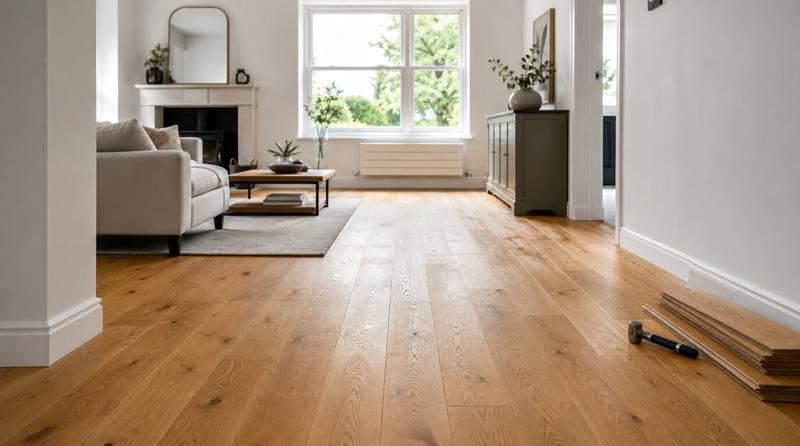
Flooring is one of those jobs where the price range is huge and the choice genuinely matters, because you will live with the result for a decade or more. Budget vinyl and premium natural stone can differ by ten times the cost per square metre, and picking the wrong material for a room often costs more to fix later than it would have to get right first time.
This guide covers realistic 2026 UK prices for every common flooring type, what drives the cost up or down, and how to budget properly whether you are doing one room or a full house.
Flooring Costs by Material
The material is by far the biggest factor in your total cost. The table below covers realistic supplied and fitted prices per square metre for 2026, assuming a level, sound subfloor with no major preparation needed.
| Flooring Type | Cost Per m² (Fitted) |
|---|---|
| Budget carpet | £15 to £25 |
| Mid-range carpet (wool blend) | £25 to £45 |
| Vinyl / LVT (luxury vinyl tile) | £20 to £45 |
| Laminate | £20 to £45 |
| Engineered wood | £45 to £90 |
| Solid hardwood | £70 to £130 |
| Ceramic tile | £40 to £80 |
| Porcelain tile | £50 to £100 |
| Natural stone tile | £80 to £150 |
Prices above include underlay or adhesive where relevant, fitting labour, and standard skirting reinstatement. They assume the existing subfloor is level and sound. If the subfloor needs levelling compound or repair, add £10 to £25 per square metre depending on the extent of the work.
Carpet and Vinyl
Carpet remains the most popular choice for bedrooms and is the cheapest option for whole-house coverage. Budget polypropylene carpets start around £15 per square metre fitted, while wool and wool-blend carpets with better durability and feel run £25 to £45. Underlay adds £3 to £8 per square metre and is worth specifying properly rather than accepting the cheapest option a fitter offers, since it significantly affects how the carpet feels and wears.
Vinyl and luxury vinyl tile (LVT) have become a popular alternative to laminate in kitchens, bathrooms and hallways because they are fully waterproof and more forgiving underfoot. Click LVT costs £25 to £50 per square metre fitted and looks convincingly like wood or stone from a short distance.
Laminate Flooring
Laminate is the most common choice for living areas and hallways because it balances price, durability and appearance well. A mid-range laminate with a realistic wood-look finish costs £20 to £35 per square metre fitted, while premium laminates with thicker wear layers and better click systems run £35 to £45.
Laminate is scratch resistant and easy to clean, making it a practical choice for households with children or pets. It cannot be sanded or refinished like real wood, so once the surface wears through, typically after 15 to 25 years, it needs replacing rather than restoring.
Engineered and Solid Wood
Engineered wood has a real wood veneer over a plywood core, giving the look and feel of solid hardwood at a lower cost and with better stability against humidity changes. It costs £45 to £90 per square metre fitted and can typically be sanded and refinished once or twice over its lifetime, extending its life to 40 to 60 years.
Solid hardwood is the premium option, £70 to £130 per square metre fitted depending on species, with oak at the lower end and walnut or exotic hardwoods at the top. It can be sanded and refinished multiple times, often lasting 80 to 100 years with proper care, making the cost per year genuinely competitive with cheaper materials over the long term.
Tile and Natural Stone
Tile is the standard choice for kitchens, bathrooms and hallways where water resistance matters. Ceramic tile costs £40 to £80 per square metre fitted, porcelain £50 to £100, and natural stone such as limestone, travertine or slate £80 to £150. Underfloor heating compatibility, discussed below, is a major reason tile is often chosen for these rooms.
Large format tiles and natural stone require a more experienced fitter and a perfectly level subfloor, both of which push labour costs higher than for standard ceramic. Grout and sealant, particularly for natural stone which needs periodic resealing, add a small ongoing maintenance cost that is worth factoring in.
What Affects the Price
- Subfloor condition: Levelling compound or repair adds £10 to £25 per square metre. Fitters will not know the full extent until old flooring is lifted.
- Old flooring removal: Carpet removal costs £2 to £5 per square metre. Tile or screed removal costs £8 to £20 per square metre since it often needs breaking out.
- Room shape and cutting: Awkward layouts, bay windows and lots of doorways increase waste and labour time, typically adding 10 to 20% to the job.
- Pattern and layout: Herringbone or chevron wood layouts take significantly longer to fit than a straight run, adding 20 to 40% to labour costs.
- Underfloor heating: Compatible flooring (tile, engineered wood) and correct installation technique add a small premium but avoid costly problems later.
- Skirting and finishing: Removing and refitting skirting boards, or fitting new scotia beading, adds £3 to £8 per metre run.
- Location: London and the South East typically run 15 to 25% higher on labour than the Midlands, North of England, Scotland and Wales.
Full Project Cost Examples
- Single bedroom (12m², budget carpet): £250 to £450 fully fitted.
- Living room (20m², mid-range laminate): £550 to £1,000 fully fitted.
- Kitchen (15m², porcelain tile): £900 to £1,700 fully fitted, including subfloor prep.
- Whole 3-bed house (70m², mixed carpet and laminate): £2,000 to £3,800 fully fitted.
- Whole 4-bed house (90m², mostly engineered wood): £5,500 to £9,500 fully fitted.
Flooring and Underfloor Heating
Tile and engineered wood are the preferred flooring types over underfloor heating because they conduct heat efficiently and are dimensionally stable enough to handle the heat cycling. Solid hardwood can warp or gap over time with underfloor heating and is generally not recommended unless the manufacturer specifically certifies it. If carpet is wanted in a heated room, use a low tog rating (2.5 or below) carpet and underlay combination, since high tog values insulate against the heat rising into the room, wasting energy and reducing comfort.
How to Save Money on Flooring
- Buy materials separately from fitting where possible. Trade flooring suppliers are often considerably cheaper than a fitter's own supply price, though confirm the fitter is happy to fit customer-supplied materials.
- Get at least three quotes. Flooring pricing varies significantly between fitters for the same specification and area.
- Prepare the room yourself. Clearing furniture and removing old carpet before the fitter arrives can save on labour time.
- Choose a straight-lay pattern. Herringbone and chevron layouts look striking but add real cost. A straight run in a quality material often looks just as good for considerably less.
- Ask about end-of-line and clearance stock. Flooring suppliers regularly discontinue lines, and clearance stock can be 30 to 50% cheaper if there is enough for your room.
- Time the job outside peak season. Late autumn and January tend to be quieter for fitters, and some offer modest discounts to keep the diary full.
Flooring in the UK costs £20 to £70 per square metre supplied and fitted for most common materials in 2026, with carpet and vinyl at the budget end and natural stone and solid hardwood at the top. A typical 3-bedroom house needs £1,800 to £6,500 depending on the mix chosen. Get subfloor condition checked before quoting, get at least three quotes, and factor in old flooring removal separately since many quotes exclude it. If you are tackling several rooms at once, see our guide on painting and decorating costs too.