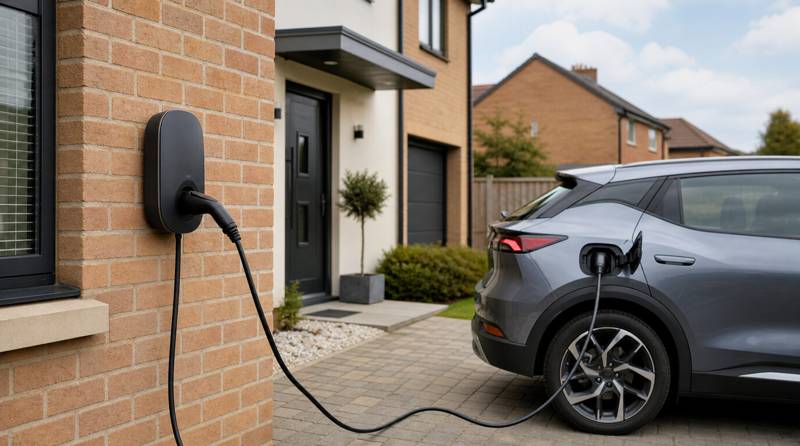
Buying an electric car is only half the decision. Working out how to charge it at home affordably is the part most new EV owners underestimate, and the market has enough variation in unit price, installer quotes and tariff options that it is easy to overpay without realising.
This guide covers realistic 2026 UK costs for installing a home EV charger, what affects the price, and how to keep your running costs down once it is in.
EV Charger Installation Costs
The unit itself is a smaller share of the total cost than most people expect. Labour, cabling and any electrical upgrades needed usually make up more than half the bill. The table below covers realistic 2026 UK prices for a standard single-phase 7kW home installation.
| Job Type | Typical Cost |
|---|---|
| Standard install, unit near parking space | £750 to £1,100 |
| Longer cable run (10m or more) | £900 to £1,300 |
| Underground trenching required | £1,200 to £1,800 |
| Consumer unit upgrade (if needed first) | £300 to £600 additional |
| Smart charger with app/scheduling | £850 to £1,400 |
| Tethered vs untethered cable (price difference) | £50 to £150 more for tethered |
Most reputable installers quote a single supplied-and-fitted price after a site survey, since cable run length and consumer unit condition vary so much between properties. Be wary of a quote given without the installer seeing your property, particularly your consumer unit and the distance to your parking space.
What Affects the Price
- Cable run distance: The further the charger is from your consumer unit, the more cable and labour time is needed. Runs over 10 metres or requiring wall penetration add cost quickly.
- Consumer unit condition: Older consumer units, particularly those without RCD protection or with insufficient capacity, often need upgrading before a charger can be safely added, adding £300 to £600.
- Underground cabling: If the cable needs to cross a driveway or garden underground rather than along a wall, trenching adds £300 to £700 depending on distance and surface reinstatement.
- Smart features: App control, scheduled charging to hit off-peak tariff windows, and solar integration all add to the unit cost, typically £100 to £300 over a basic model.
- Tethered vs untethered: A tethered charger has a built-in cable, more convenient but slightly pricier. An untethered charger just has a socket, requiring you to carry your own cable, and costs a little less.
- Location: London and the South East typically run 10 to 20% higher on labour than the Midlands, North of England, Scotland and Wales.
Grants and Financial Support
The EV Homecharge Scheme (EVHS) that once subsidised homeowner installs closed in March 2022. Support that remains available in 2026 is more targeted.
- OZEV grant for renters and flat owners: Covers up to 75% of installation costs, capped at £350, for households with dedicated off-street parking who rent or live in a flat. Homeowners with a driveway are generally no longer eligible.
- Workplace Charging Scheme: Available to businesses installing chargers for staff and fleet vehicles, up to £350 per socket for up to 40 sockets. Not applicable to home installs but relevant if you run a business from home with dedicated parking.
- Local authority schemes: Some councils run their own top-up grants, particularly for residents without off-street parking who need on-street charging infrastructure. Availability varies significantly by area, so check your local council's website.
Always confirm grant eligibility and use an OZEV-approved installer before booking, since using a non-approved installer disqualifies you from any grant regardless of your circumstances.
Running Costs
Installation is a one-off cost, but running costs are what you will actually notice month to month. This is where tariff choice makes a genuinely significant difference.
| Tariff Type | Typical Rate | Cost for a 60kWh Full Charge |
|---|---|---|
| Standard variable tariff | 26p to 30p per kWh | £15.60 to £18.00 |
| EV-specific overnight tariff | 7p to 10p per kWh | £4.20 to £6.00 |
| Economy 7 (off-peak hours) | 12p to 16p per kWh | £7.20 to £9.60 |
| Public rapid charger (for comparison) | 45p to 79p per kWh | £27.00 to £47.40 |
Switching to an EV-specific tariff is close to essential once you own a charger. Most major suppliers now offer one, and the saving on a typical driver's annual mileage easily exceeds £300 to £500 compared with charging on a standard variable rate.
How to Get the Best Price
- Get at least three quotes from OZEV-approved installers. Pricing varies meaningfully between installers for identical specifications.
- Ask for a site survey before accepting a quote. A quote given without seeing your property and consumer unit is unreliable.
- Switch to an EV tariff immediately after installation. This has a bigger financial impact than negotiating the install price down.
- Consider an untethered unit if cost is tight. The saving is modest but real, and you retain flexibility to use different cable lengths.
- Bundle with other electrical work if planned. If you are already having consumer unit work done for another reason, adding the charger at the same time saves a second callout.
A home EV charger costs £750 to £1,400 fully installed in the UK in 2026, with most straightforward jobs landing around £850 to £1,100. The bigger financial decision is your electricity tariff, since switching to an EV-specific overnight rate can cut charging costs by 60 to 75% compared with a standard tariff. Always use an OZEV-approved installer, get a proper site survey, and check current grant eligibility before booking. If you are planning other home electrical upgrades, see our guide on solar panel installation costs too.